
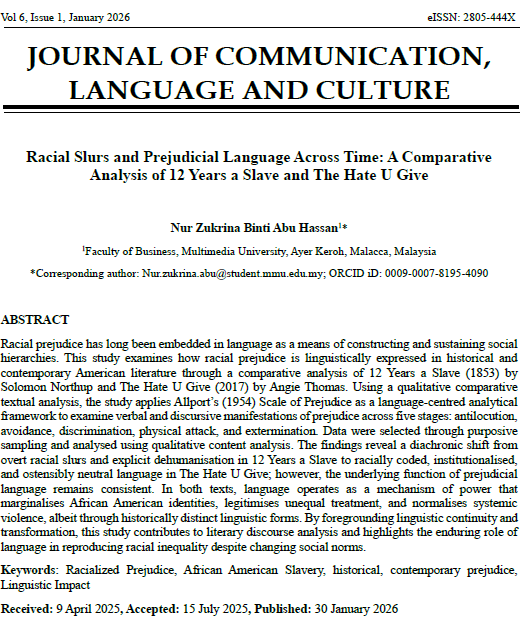
Racial Slurs and Prejudicial Language Across Time: A Comparative Analysis of 12 Years a Slave and The Hate U Give
Article Sidebar
Main Article Content
Abstract
Racial prejudice has long been embedded in language as a means of constructing and sustaining social hierarchies. This study examines how racial prejudice is linguistically expressed in historical and contemporary American literature through a comparative analysis of 12 Years a Slave (1853) by Solomon Northup and The Hate U Give (2017) by Angie Thomas. Using a qualitative comparative textual analysis, the study applies Allport’s (1954) Scale of Prejudice as a language-centred analytical framework to examine verbal and discursive manifestations of prejudice across five stages: antilocution, avoidance, discrimination, physical attack, and extermination. Data were selected through purposive sampling and analysed using qualitative content analysis. The findings reveal a diachronic shift from overt racial slurs and explicit dehumanisation in 12 Years a Slave to racially coded, institutionalised, and ostensibly neutral language in The Hate U Give; however, the underlying function of prejudicial language remains consistent. In both texts, language operates as a mechanism of power that marginalises African American identities, legitimises unequal treatment, and normalises systemic violence, albeit through historically distinct linguistic forms. By foregrounding linguistic continuity and transformation, this study contributes to literary discourse analysis and highlights the enduring role of language in reproducing racial inequality despite changing social norms.